





All welcome, for more info or to register, call Chris on 0403 013 183 or email melbourne [at] solidarity.net.au
11.30am: The economic crisis: over or just beginning?
Australia has so far appeared immune from the economic crisis. But the debt crisis engulfing Europe and the slowing down of “recovery” in the US suggests it isn’t over yet. Shannon Price will take a look at the state of the world economy and what it means for us.
12.30 -1.30pm lunch (note two sessions run simultaneous after lunch at 1.30pm)
1.30pm: Why does racism still exist?
Tony Abbott has sought to win votes in the election by stirring up racism against refugees, and Julia Gillard has followed suit. Both are also agreed on continuing the racist NT Intervention. Jasmine Ali will look at why so many people accept the myths about refugees and Aboriginal people, and how such racism was unknown just a few centuries ago.
1.30pm: Is the working class still a force for change?
The continued relevance of class has been widely attacked in recent decades. The erosion of traditional blue-collar jobs and the strength of trade unions over recent decades has also led to claims that workers no longer had the potential power they once did. Yet inequality in Australia is on the rise and the union Rights at Work campaign to unseat Howard showed that unions still have potential strength. Lucy Honan analyses the working class today and why it retains immense potential power to change society.
3.00 pm Debate: Does there have to be a price on carbon?
From Gillard to the Greens the demand for a ‘price on carbon’ is widespread. Would it make the polluters pay or would it hurt living standards? What would the effect be on emissions? What about regulation and public investment in renewable energy? Can we support both?
4.30pm After the election: Labor, The Greens and the balance of power
In the aftermath of the election, Adam Bandt (newly elected Greens MP) & James Supple (Solidarity) will discuss the result and what it means. If Julia Gillard hangs on what will she be like as prime minister? What difference will it make if the Greens win the balance of power in the Senate? And how can the left rebuild itself and pose and alternative to the neo-liberal politics of Labor in power?
Forty years ago, the margins strike provided a model example of how to involve rank and file union members in action in defiance of the law and win, argues Tom Orsag
Review: Killer Company
By Matt Peacock, ABC Books, $35.00
Labor has a climate policy basically identical to the Liberals. Rudd’s drop in support after junking the CPRS, and the votes heading to The Greens, suggest a substantial minority is frustrated by this. The space is open for the climate movement to put an alternative on the map—but where is it?
There is a rising tide of anger and determination amongst Chinese workers. In the face of some of the most regressive labour laws in the world, workers are openly striking to demand better wages and the right to form their own representative organisations.
The Black Moratorium marches in 1972 were amongst the most successful protests for Aboriginal rights ever in this country. Paddy Gibson explains how the unity between Aboriginal activists and organised workers was central to their success.
Thousands rallied across the country as building worker Ark Tribe faced trial on June 15. He is the second person to face six months jail for refusing to answer questions at the anti-union Australian Building and Construction Commission (ABCC).
Students nationwide sat the National Assessment Program–Literacy and Numeracy (NAPLAN) tests in May after the education unions called off their proposed moratorium on the tests. While representatives of the unions are now sitting on Julia Gillard’s My School Working Party, teacher activists need to be ready to restart action against NAPLAN if, as is likely, the working party fails to deliver.
Greece exploded again in strikes and protests at government cutbacks, as European leaders and the IMF were forced to fast-track emergency loans to the Greek government, increased in size to €110 billion.
Nationwide union rallies will mark the first day of Ark Tribe’s trial on June 15. Ark is the second unionist to face six months jail for refusing to answer questions from the ABCC.
The Australian Education Union and state teachers unions’ have backed away from a confrontation with Julia Gillard over the NAPLAN tests. But the battle to stop league tables, and the tests themselves, is far from over.
This year unions have launched a new equal pay campaign, “Pay Up”, in recognition of the persistent inequality in wage levels. Women make up half of the Australian workforce yet on average earn 17 per cent less than men.
Three hundred coalminers at the Xstrata-owned Tahmoor coal mine in NSW have been fighting for their rights and conditions since late 2008.
In the aftermath of wild cat strikes in January and February over motelling, construction unions in the Pilbara have begun an industrial campaign targeting one contractor at a time over unresolved issues such as travel time.
Workers at Sigma’s Herron pharmaceutical plant in Tennyson, Brisbane walked out on a week-long strike in February over their employer’s unfair redundancy offer.
A planned 24-hour strike at Sydney’s Star City Casino during Chinese New Year was banned by a decision of Fair Work Australia. This is one of the busiest times of the year at the Casino and would have caused serious disruption.
The eight-day strike over motelling at Woodside in Western Australia has ended in a draw. But the industrial battle isn’t over by a long shot—not for Woodside, and not for the workers and unions hit by massive fines by Fair Work Australia.
“The best union meeting I’ve attended in years.” That was the response of many NSW TAFE teachers after a 3000-strong mass meeting filled and electrified the inside of Sydney Town Hall on 11 February.
Employers in WA’s Pilbara region have warned that militant strikes at Woodside’s Pluto site could spread across the whole resources sector. The Woodside strikers have defied threats of huge fines under Rudd’s anti-union laws to stage an eight-day strike, and further action looked likely as Solidarity went to press.
Rudd’s new work laws, like Howard’s, are designed to criminalise effective strike action—and intimidate workers out of using it.
Up to 20,000 union members went on strike at Australia Post in December, part of a pre-Christmas rush of strikes that also hit Sydney buses, Telstra and Qantas. MUA members in the Western Australian offshore oil and gas fields also went on strike.
Workers at Woodside’s $12 billion Pluto gas site are fighting plans to take away stable on-site accommodation.
National teaching unions are set to ban upcoming National Assessment Program—Literacy and Numeracy (NAPLAN) tests. The move comes after newspapers in Canberra, Sydney and Melbourne used information from the Rudd government’s “My School” website to rank school performances in so-called league tables.
Workers at Star City Casino in Sydney have taken three rounds of strike action over their employers’ lousy pay offer.
Clerical workers at The Age newspaper have gone on strike for the first time ever as part of enterprise bargaining agreement (EBA) negotiations.
Up to 1600 workers have defied court orders and calls by the Rudd government to end strike action at Woodside Petroleum’s Pluto gas site in Western Australia.
Up to 20,000 union members have taken strike action at Australia Post, part of a pre-Xmas rush of strikes that also hit Sydney buses, Telstra and Qantas.
The run of pre-Xmas strikes are a welcome start in reversing years of management bullying, privatisation and job cuts. The limited revival of industrial struggle by workers marks a shift in the terrain for the Labor government.
A union push to overturn the NSW government’s privatisation drive failed to materialise at the Labor state conference in mid-November.
The leadership of the Queensland Teachers Union (QTU) has sold its members a dud pay offer. During a fortnight long propaganda barrage, they managed to convince 82 per cent of the membership that retreat was in fact some sort of victory.
Recent elections in the Victorian branch of the Australian Education Union (AEU) have taken place at a challenging time for public schools and teachers.
State education minister Bronwyn Pike has wholeheartedly signed onto the national policy agenda being promoted by Julia Gillard, which includes standardised testing, school comparison tables and performance pay.
TAFE Teachers across NSW have walked off the job in protest at the combined attack on their working conditions from the NSW government and the Industrial Relations Commission (IRC).
A generation of neo-liberal attacks dressed up as reform or restructuring have created deep suspicion among many workers about anything that’s described as “streamlining” conditions.
And people are right to be cautious. Take the current round of award modernisation, which could lead to some workers losing $300 a week or hard-won conditions.
Labor’s Fair Work Act has lifted the sense of intimidation felt about union membership among many workers.
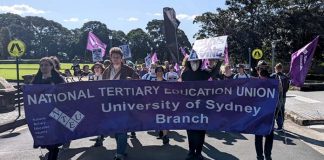
National Tertiary Education University members at 16 universities across the country stopped work on September 16 as part of the NTEU national bargaining round to fight increased workloads, a blow-out in class sizes, casualisation and other attacks on jobs and conditions.
Anna Bligh was hoping that a combination of time and spin would be enough for Queensland workers to get used to her unpopular decision to privatise $15 billion worth of public assets. How wrong she was.
The 2009 NSW Labor conference is shaping up to be a focal point of anger at the Nathan Rees government. At the Sydney Entertainment centre on the weekend of 15, 16 November, Rees will face defiance both inside and outside the conference.
Review: Framework of Flesh
By Humphrey McQueen, Ginninderra Press, $30
A march by hundreds of workers to a union fringe event on the Labor conference’s second day was one of the few brights spots where there was some challenge to Rudd’s conservative agenda.
As Queensland teachers geared up for a state-wide strike, Queensland’s Labor Government has used the state’s industrial laws to drive the wage dispute into the Queensland Industrial Relations Commission.
Melbourne University NTEU members are in a battle with the University of Melbourne to stop a proposed 220 job attrition.
The battle for union rights under the Rudd Labor government is set to hot up in August, when building workers around the country go on strike in support of Ark Tribe, a South Australian union member, who faces court on August 11.
“The most dramatic industrial clash that has ever shocked Australia”, that was how Sydney’s Daily Telegraph described the police attack on protesting miners, December 16, 1929 at the Hunter Valley’s Rothbury Colliery.
It was so close. There were just eight votes in the decision at Brisbane’s Treasury Casino to accept the company deal (see story p 22). There are two main reasons the Casino dispute went the bosses’ way—the laws and the union officials.
Anger and resentment is running high among workers at Brisbane’s Treasury Casino. Eight months of bargaining and two cancelled strikes have left us with a sub-standard agreement.
IN EARLY June Thiess Services sacked four union members for pushing a union collective agreement with the company.
Anna Bligh’s Labor government is well and truly on the nose following its decision to privatise $15 billion worth of public assets.
The gap between unions and the NSW state Labor government continues to widen. At the end of June Unions NSW unveiled its new response to the privatisation offensive at a meeting of public sector delegates and organisers.
WORKERS AT five universities in Melbourne—Melbourne, Monash, Swinburne, RMIT and Deakin, plus a Hawthorn college —went out on strike on Thursday, May 21.
On April 28, over 10,000 building workers in Melbourne and 3000 in Brisbane took illegal strike action against the Howard-era anti-union Australian Building and Construction Commission (ABCC). The Rudd government still gives $33 million to the ABCC to police union activities on building sites.
On Tuesday May 19, 30,000 Queensland teachers held a 24-hour strike over the measly 12.5 per cent pay rise over three years offered by the Queensland Government. The Queensland Teachers Union (QTU) convened 49 meetings across the state, the largest in Brisbane with over 4000 workers.
As Solidarity went to press the results of the Brisbane Treasury Casino strike ballot were released.
With Cessnock jail off the privatisation list, union activists including prison guards (PSA), teachers (NSWTF), nurses, AMWU and NTEU are seeking to extend the campaign across the state.
“This was a great day for the Cessnock community—and a good result for all those in the community who do not believe that prisons should be run for profit by big corporations,” said PSA general secretary John Cahill.
Cahill says that the PSA will now target Labor MPs in the western Sydney electorates surrounding the Parklea prison—still up for sale by Corrective Services Minister John Robertson.
“The arguments against a private prison at Cessnock are the same as the arguments against a private prison at Parklea—the justice system should not be run for profit,” said PSA general secretary John Cahill.
On May 31, stalls were held in about 20 electorates across NSW targeting Labor MPs who still support the government privatisation push—of prisons, power services and generators, ferries, lotteries and rail services. The Labor heartland seats of right wing power brokers, Joseph Tripodi and Eddie Obeid, were among those targeted.
These are the same people who backed former treasurer Michel Costa’s 2008 attempt to privatise NSW power generators. Union opposition to this neo-liberal agenda saw both Premier Morris Iemma and Treasurer Michael Costa lose their government positions last year.
Current Premier Nathan Rees and other members of cabinet must ditch their privatisation plans once and for all. Polling shows that Labor faces a hiding in the next election.
Junking their Liberal-esque policies might be a start to turning that around.
Around 800 party and union members rallied outside a meeting of the party’s administrative committee to demand that the committee uphold the NSW party’s position against privatisation.
The Labor government is trying to get the committee to re-interpret the meaning of ALP policy which states “Labor opposes the private contract management of prisons”.
Rather than imposing cuts, the NSW government should be boosting government spending for public sector employment such as green power jobs as well as metro and light rail extension.
By John Morris
A united cross-union campaign against the NSW government’s privatisation fire sale is needed, as prison workers continue their fight against privatisation.
Two hundred police moved in to break up picket lines on Melbourne’s Westgate bridge on April 15, where 39 workers have held out since December in a dispute with their employer.
Builder John Holland has now agreed to mediation with the unions in return for an end to the union pickets. The outcome was unclear as Solidarity went to press.
A BETWEEN-SHIFT mass meeting of over 100 Conrad Treasury Casino workers in Brisbane has voted unanimously to initiate a ballot for industrial action in support of their claim for 5.5 per cent for each of the next three years.
UNIONS ARE stepping up their campaign to have the Australian Building and Construction Commission scrapped, with strike-day rallies around the country on April 28.
Workers at Waterford Crystal in Ireland have secured 176 jobs in the plant after an eight week long occupation of their workplace. Their example has begun to inspire other workers to occupy in defence of jobs across the UK.
QUEENSLAND TEACHERS are set to vote for 24-hour strikes from the beginning of May. Well-attended mass meetings voted overwhelmingly to hold a publicity and industrial campaign to win their claim for wage parity with teachers in other states. Queensland teachers are currently the lowest paid on the mainland.
Review: The State of Industrial Relations
Evatt Foundation, $24.95
NSW unions are again locked in battle with the state Labor government over privatisation. With the government accelerating its planned sell-off of prisons, members of the Public Service Association (PSA) were set to strike and rally outside NSW Parliament on Tuesday April 2 as Solidarity went to press.
Despite its promise to create jobs in the economic downturn, the Rudd government is imposing job cuts on the federal public service.
Anger at the Irish government’s response to the recession has exploded into angry and growing protests. Over 120,000 joined a protest in Dublin in late February, and unionists are campaigning for a public sector-wide strike.
WORKERS AT Brisbane’s Treasury Casino are getting restless. The casino EBA expired on December 31, 2008. Since negotiations started in November 2008, Tabcorp, the Casino owners, have made just one paltry offer of a 3.5 per cent wage rise.
MINOR CHANGS saw Rudd pass his “WorkChoices-lite” package through the Senate in late March.
Profitable companies are using the economic crisis as an excuse to sack workers and slash wages.
Despite a 9 per cent rise in profit to $713 million dollars last financial year, Fosters has outsourced the jobs of over 100 maintenance workers at its Abbotsford plant in Melbourne through a labour hire company.
Bosses at Drivetrain Systems have used “divide and conquer” tactics to stop workers resisting mass sackings at an Albury-Wodonga gearbox factory.
On February 25 meetings of approximately 200 members of the National Tertiary Education Union (NTEU) at the University of Sydney voted to seek a ballot authorising industrial action in our enterprise bargaining campaign. The ballot opens on March 27.
Six hundred workers are occupying the Waterford Crystal factory in Ireland after receivers tried to sack them and close the plant.
Telstra workers went out on a strike for the second time in two months on Monday February 9. Following on from a four-hour stoppage late last year, unions called a 24-hour strike.
NSW TEACHERS have won a pay increase and the reinstatement of a state-wide staffing plan as part of a new 3-year-award.
As unemployment edges upwards, the myth that cutting wages can save jobs is being promoted once again. Accepting this would be a huge mistake that will hurt our living standards and make the recession worse.
Review: Trade Unionism in Australia: A history from flood to ebb tide, By Tom Bramble , Cambridge University Press, $49.95
NSW teachers have won a pay increase and the reinstatement of a state-wide staffing plan as part of a new 3-year-award.
A not-for-profit consortium led by Community Childcare Co-operative NSW has made a bid for 241 ABC childcare centres that the company’s receivers had deemed “economically unviable”.
Union members in the National Tertiary Education Union (NTEU) have faced down compulsory redundancies at Victoria University (VU) and the University of Melbourne (Melbourne Uni) by taking industrial action.
So far the world economic crisis has not had the same impact in Australia as in the US or Europe. A few months ago some pundits were confidently predicting Australia could weather the storm. But now the discussion is about how bad the economic problems will get.
As Solidarity goes to print, the fate of up to 386 ABC Learning child care centres is in doubt. That represents one-tenth of the national child care resources. The centres look after 30,000 children and employ over 4000 people.
The final piece of Labor’s new industrial relations regime has been unveiled by Workplace Relations Minister Julia Gillard. The new legislation was hailed by Gillard and most of the media as bringing the end of WorkChoices.
The shocking announcement a few weeks ago of the largest ever mass sackings in Australia’s higher education sector at Victoria University (VU) prompted a well attended protest rally in a quiet time of the academic year.
In the context of the global financial crisis, governments across the world have abandoned financial conservatism, proposing significant expenditure programs, often funded through debt.
Twenty thousand teachers at meetings around NSW have voted to take 48 hours of industrial action at the start of the 2009 school year, in the event of the NSW government not abandoning its attacks on wages, conditions and the staffing of public schools.
The union campaign against WorkChoices succeeded in getting Howard voted out, but has not put unions in a stronger position to organise and fight. Solidarity examines why
In 1969 over one million workers took part in a general stoppage and won the freedom of jailed union official Clarrie O’Shea and an end to the penal powers. With the ABCC and most of the WorkChoices laws intact, Amy Thomas looks at the lessons for today.
20,000 teachers at meetings around the state have voted to take 48 hours of industrial action from the start of the 2009 school year, in the event of the NSW government not abandoning its attacks on wages, conditions and the staffing of public schools.
Last issue Solidarity reported that Telstra workers in the Wholesale and Service Advantage area had voted down a non-union collective agreement. It was a serious blow to Telstra’s divide and rule strategy of pushing such agreements onto poorly-unionised sections of the company.
TRAIN DRIVERS in the Pilbara region of Western Australia have taken strike action as part of a struggle to establish a collective union agreement with mining giant Rio Tinto.
In the midst of global panic last month, the University of Sydney’s Vice-Chancellor announced shock budget cuts of up to 9 per cent because of a shortfall of $100 million in investment income.
NSW teachers will continue their campaign for salary and staffing justice with statewide stopwork meetings on November 19.
The economic devastation that gripped Australia during the 1930s dealt an almost fatal blow to the organised labour movement. In the face of mass sackings and wage cuts, there was little political clarity about how to respond to the attacks on the working class and even less confidence that resistance was possible.
In the 1970s the Builders Labourers’ Federation led inspiring struggles in defence of the natural environment. Emma Torzillo looks at the history of an inspiring struggle when workers took industrial action and declared the social responsibility of labour
THOUSANDS OF building workers across the country are set to strike on December 2, when Noel Washington, senior vice president of the Victorian branch of the CFMEU, goes on trial for two days in Geelong.
What does it do for the union movement’s credibility when its elected leader joins the government?
OVER 3000 Brisbane construction workers walked off the job for a mass stopwork meeting in central Brisbane on September 12.
NSW TEACHERS are still seeking a salary raise of 5 per cent or more and an end to restrictions on transfers. The October state council meeting of the New South Wales Teachers Federation (NSWTF) is to consider renewed state-wide industrial action over both issues.
PUBLIC SECTOR workers rallied in Brisbane on September 30 to protest over the state government’s paltry 3.25 per cent wage offer. Over 3000 workers participated in the rally.
A COLD, wind-swept day did not stop over 120 Melbourne Uni staff and students joining a protest against university management’s plan to sack 20 academics in the arts faculty. The protest was called by the National Tertiary Education Union (NTEU), the union representing most staff at the university.
WORKERS AT Telstra have voted to reject the collective non-union agreement the company was trying to force on them. This is a major defeat for Telstra’s efforts to cut unions out of the workplace.
FURTHER DETAILS about Labor’s new IR laws confirm that the new government will retain the bulk of WorkChoices. Legislation will be introduced into parliament before the end of the year.
Join the campaign to abolish the Australian Building and Construction Commission.
Solidarity speaks to Marcus Strom, a member of the Fairfax union house committee, about the ongoing dispute at Fairfax.
A mass meeting of 6000 Victorian building workers, members of the CFMEU, in late August, voted to accept the latest EBA put to them by the union officials.
THE BELIEF that the Rudd government will bring change is still strong. But many people wish the government was moving more quickly to undo Howard’s legacy.
VICTORIAN BUILDING unions are set to hold a mass stopwork rally in defence of Noel Washington, the construction union official facing six months jail for defying Howard’s industrial laws.
IN THE wake of the federal election victory for Labor, the CPSU is holding a series of Agenda For Change discussions around the country.
2000 union delegates attended a mass meeting to defend Noel Washington, CFMEU official facing 6 months jail for refusing to be interrogated by the Howard era Australian Building & Construction Commission (ABCC). The ABCC wanted to question him about what was said at a union meeting that took place outside of work hours.
THE LATEST humiliating back-flip by the NSW government over its planned power sell-off indicates two things.
Firstly, NSW Labor is facing a serious crisis. According to the polls, the Liberals are in a position to win the 2011 election. Secondly, the campaign against the sell-off has reached a turning point that requires urgent re-evaluation.
NSW public sector unions including public servants, firefighters and train drivers are planning a united day of action on July 30 against the state government’s 2.5 per cent pay rise limit.
The Your Rights at Work campaign mobilised thousands of unionists to campaign against the Howard government and its vicious Workchoices laws. Yet over six months into the Rudd government’s term, unions are still constrained by Howard’s laws.
On Saturday morning June 21 two construction workers were killed when their swing stage scaffolding fell from the side of a Gold Coast high-rise building site. The next day building sites across Brisbane and South-east Queensland were shut down by a spontaneous walk off by workers sick of falling safety standards.
Unions in Victoria are set to escalate their campaign against the anti-union Australian Building and Construction Commission (ABCC), a WorkChoices-era relic. For the first time since Howard introduced the ABCC a unionist, Noel Washington, will face court for refusing to attend an interrogation by the commission.
NURSES IN NSW have accepted a pay deal in exchange for a raft of “trade offs” that strip back work conditions. The nurses’ is the latest in a string of public sector disputes where unions are battling state Labor governments’ below-inflation pay caps.
IN MAY, around 1500 Qantas aircraft engineers took strike action in Sydney, Brisbane and Melbourne over a pay claim. They took this action despite rumours of 100 strike breakers being offered $100,000 for six months work in their place.
NSW TEACHERS will continue rolling industrial action unless the New South Wales government sits down and negotiates on proposed changes to the school staffing and transfer system.
Mark Gillespie looks at the Queensland rail strike of 1948, when the Communist Party led workers in a vicious battle with a state Labor government determined to keep down wages.
IS RUDD’S honeymoon coming to an end? Recent weeks have seen him blunder over fuel prices, his Howardesque moralism over Bill Henson and brewing battles with unions over pay disputes and the rollback of Workchoices.
THE CAMPAIGN against electricity privatisation has reached a critical stage in NSW.
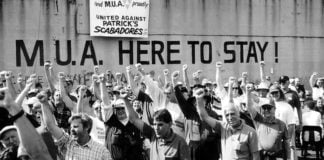
In the middle of the night on April 7th 1998, security guards, some in balaclavas, emerged from rubber dinghies and buses with dogs and barbed wire, entered Patrick Stevedoring terminals across the country and escorted the night shift from the wharves.
When the Fair Pay Commission holds its annual National Minimum Wage Case hearing in mid-2008, the major employers will propose cuts to real wages. As food, petrol and housing prices go up (along with CEO salaries) bosses want to keep workers’ wages down.
THOUSANDS OF union members marched last month against the NSW government’s plans to privatise electricity. Despite industry claims otherwise, two-thirds of the state is opposed to the policy.
On Saturday March 8, 300 delegates at the NSW Teachers Federation (NSWTF) state council voted unanimously to strike in opposition to the Iemma government’s plan to deregulate the supply of teachers to schools.
MAY DAY in the US this year was marked by dockworkers along the West Coast taking industrial action against the US-led wars in Iraq and Afghanistan. Some 25,000 members of the International Longshore and Warehouse Union (ILWU), representing 29 ports from Seattle to San Diego, took part in the 8-hour day stoppage during their busy day shift.
Six months after Labor’s election, unionists are still fighting Howard’s laws. Dave Kerin of Union Solidarity has been summonsed by the workplace ombudsman to “produce documents” over the Boeing dispute, under a clause of the Howard government’s Workplace Relations Act (predecessor of WorkChoices).
WORKERS AT Boeing subsidiary Hawker de Havilland in Port Melbourne have successfully defied anti-strike laws to take action in defence of a sacked workmate.
NEW FIGURES showing a dramatic drop in union membership in 2007 highlight the challenges facing the labour movement as it attempts to rebuild after the Howard years.
Noel Washington, an official with Construction Division of the Victorian CFMEU, will be called before a court after refusing to be interrogated by the Australian Building and Construction Commission (ABCC), a Howard-era anti union body, funded by taxpayers.
After three state-wide strikes and five weeks of rolling stoppages, some Victorian teachers have won large pay increases of 10 and 15 per cent over the next year in an “in-principle” agreement between the Australian Education Union (AEU) and the Brumby government.
ON MARCH 4, the Australian Council of Trade Unions (ACTU) announced its support for a new proposal to transfer this year’s planned $31 billion tax cuts directly into superannuation funds. The decision by the ACTU to back the proposal is a turning point for a body that has historically, and quite rightly, opposed tax cuts in general, in favour of social spending on services like health and education. The “reasoning” behind the proposal is that it will help to curb rising inflation by delivering neither the planned tax cuts, nor increased government spending. Despite increases in the cost of living, the message is clear: the new government has to prove that it can match Howard’s legacy of “fiscal responsibility”-a Liberal Party catch-cry that over eleven years further accentuated the gap between rich and poor.