


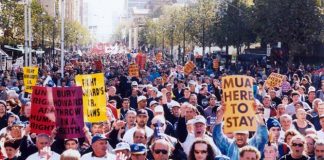


A standing room only crowd of around 700 people gathered at Melbourne University in July for the launch of Beyond Zero Emissions’ (BZE) Zero Carbon Australia Stationary Energy Plan. The turnout shows the popularity of their approach to climate solutions, which is to look at achieving the emissions reductions necessary to halt climate change, while maintaining living standards and social equity.
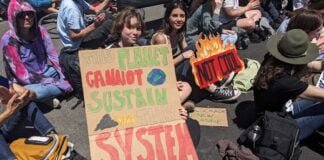
In early July students and activists from across Australia gathered at Flinders University in Adelaide for the annual Students of Sustainability (SoS) conference, a yearly environmental event.
Labor’s slide in the polls has seen substantial numbers of voters move towards The Greens.
On current polling, The Greens will win between 12 and 16 per cent of the vote at the next election, enough to secure them the balance of power in the Senate.
The federal government revealed the first projects shortlisted for funding under its Solar Flagships scheme back in May.
Labor has a climate policy basically identical to the Liberals. Rudd’s drop in support after junking the CPRS, and the votes heading to The Greens, suggest a substantial minority is frustrated by this. The space is open for the climate movement to put an alternative on the map—but where is it?
It’s hard to grasp the awesome scale of the catastrophe in the Gulf of Mexico caused by the Deepwater Horizon oil disaster. It is definitely the US’s biggest ever environmental disaster—and may be the worst in world history.
Nuclear power is no solution to climate change, explains Ben Dharmendra
The shelving of the CPRS until 2013 is a good thing—and not just because the scheme was hopelessly flawed. It means there is now space for a real debate about solutions to climate change, explains James Supple
Many climate activists, along with The Greens and Electrical Trade Union, are starting to demand feed-in tariffs for renewable energy. Proponents say they are a market mechanism that gives certainty to business to invest in renewables.
Last month climate activists demonstrated against the NSW government’s coal expansion outside state government offices in Sydney. The action was a response to “concept approval” for two new coal-fired power stations in NSW.
Rudd’s decision to junk the CPRS shows him up for the kind of politician he is—willing to sacrifice something he once called the “greatest moral challenge of our generation” in the name of election-year pragmatism.
Arguments that population is to blame for climate change distract from real solutions to environmental problems and only serve to boost racism, argues James Supple
Climate activists gathered outside the office of Peter Batchelor in late March. Batchelor is Victoria’s Minister for Energy and Resources and was due to attend the Victorian Coal and Energy conference to spruik plans for new coal projects in Victoria.
Huge electricity price rises in NSW show that Rudd’s CPRS will have more impact on power costs for working people than the government has admitted.
This year’s national Climate Summit voted to demand a carbon tax during the federal election campaign. Many viewed it as an alternative to Rudd’s useless CPRS carbon trading scheme.
But there are fundamental similarities between carbon trading and a carbon tax.
The campaign to stop new coal power stations is shaping up as one of the key issues for the climate movement—both in NSW and nationally.
Australia could cut emissions from electricity generation to zero in ten years for $40 billion a year, according to a preview of Beyond Zero Emissions’ first Zero Carbon Australia plan.
A carbon tax, proposed by The Greens as an alternative to Rudd’s CPRS, would increase power prices for ordinary people, and be just as ineffective in encouraging renewables as carbon trading
We can’t trust the future of our planet to big business, argues Amy Thomas
Review: Storms of my grandchildren
By James Hansen, Bloomsbury, $35
The Greens’ Proposal
The Greens have proposed an interim 2 year carbon tax, as a transition to
carbon trading. Starting at $23 per tonne this year, rising to $24 the
following year.
As the politicians prepare for this year’s federal election, Liberal attack dog Tony Abbott has pulled the mainstream political debate to the right. But it is only Rudd’s right-wing agenda that has allowed this.
Rudd’s reintroduction of his emissions trading legislation in parliament is a stunt designed to keep the pressure on a divided Liberal Party. His CPRS will not be passed before the election—and that is a good thing.
Recent scandals over evidence in the Intergovernmental Panel on Climate Change (IPCC) report of 2007 have been used to cast doubt on the danger climate change presents.
The Copenhagen summit was a failure and a betrayal of the world’s people by their leaders. The only outcome was an “accord” which was simply “noted” by the summit. It includes no binding targets for reducing emissions and no process for agreeing to any.
The implosion of the Liberals and the collapse of the CPRS provides a chance to push for real solution to climate change
World leaders are incapable of agreeing to the action necessary to halt dangerous climate change. It is already clear that there will be no deal on reducing greenhouse gases finalised when they meet in Copenhagen.
Summit host, Danish Prime Minister Lars Lokke Rasmussen, has admitted as much. But negotiators still hope to be able to announce some face saving “progress” after the summit. Rasmussen has talked of a “politically binding” agreement—where countries agree on the major issues and defer final drafting to next year.
However, if anything is agreed it will have no substance. The world’s richest countries have all refused to budge on two key issues—committing to serious emissions cuts and providing climate aid to developing countries.
The US—the world’s largest economy—could well derail the whole summit. Obama has failed to get a climate bill through the US Senate, meaning his commitments are not binding. Obama’s announced target of 17 per cent cuts on 2000 levels works out to only 3 per cent on 1990 levels, much less than was required under the Kyoto protocol.
Australia is another guilty party delaying action—refusing to put any figure on climate aid it is prepared to offer to the developing world.
African nations have threatened to walk out of the negotiations if the rich countries do not shift. They have called for emissions cuts of at least 40 per cent by 2020 and increased aid offers to help them install renewable technologies and adapt to the impacts of climate change.
Rudd was singled out by African representatives as one of the world leaders failing to deliver on his rhetoric.
Sudanese diplomat Lumumba Di-Aping demanded, “Tell me of any politician who delivered on his political manifesto. Was it Gordon Brown? Was it Kevin Rudd?”
Why they won’t act
Ending the addiction to fossil fuels will impose major costs on businesses worldwide. No government wants its economy to bear a greater cost of cutting emissions than its rivals, and each country is working to make sure their local businesses get a better deal than overseas competitors.
This is why, as Marian Wilkinson wrote in the Sydney Morning Herald, the talks are “bogged down in an elaborate game of chicken with the players waiting to see who will blink first.”
The stalemate is a product of the nature of the capitalist economy itself. Corporations must maintain competitive against their rivals. A company capable of lowering its production costs and undercutting rivals can drive them out of business. So a decision by any national government to impose higher production costs—through forcing businesses to pay the higher power costs associated with installing renewable energy—is something they want to avoid.
World leaders are engaged in a game of imperialist competition, defending the interests of their country’s major industries. Unless there is pressure on them from a mass movement, governments will put business profits before the planet.
However, the outcome at Copenhagen is only the beginning of the struggle to demand action from governments on climate change.
The pathetic “targets” each country is offering in emissions reductions can disguise another crucial question—how they intend to actually meet their target.
Many countries are implementing emissions trading schemes—like Rudd’s Carbon Pollution Reduction Scheme (CPRS).
Business favours such schemes as they both make it easy for them to avoid cutting emissions and guarantee that ordinary people will bare any cost to the system. In addition to the billions in compensation polluting industries have been able to exact from Rudd’s CPRS and the proposed US scheme, companies can buy up dodgy “offsets”—which claim to reduce emissions overseas—instead of cutting emissions themselves.
A recent Greenpeace report exposed how investors claimed 55 million tonnes of carbon was offset by a major reforestation project in Bolivia—but it actually captured just 10 per cent of that figure.
Carbon trading was a key part of the Kyoto protocol, and will be at the heart of negotiations at Copenhagen.
In contrast to the efforts of world leaders, ordinary people worldwide will be taking to the streets during the summit to demand action.
Tens of thousands from across Europe are expected to protest in Copenhagen itself. As Jørn Andersen, from the Climate Movement in Denmark explained:
“The way the preparations for the talks have gone confirms what many on the left are saying—that governments are bound up with corporate interests and won’t do what’s needed to stop climate change.
“If we have a big protest it can be the start of building a real movement demanding socially just, global solutions to climate change.”
By James Supple
With the Senate unable to pass the CPRS, Rudd could be taking his amended scheme to the next election. The deal negotiated by Penny Wong to secure Malcolm Turnbull’s support massively increases the handouts to business.
The climate movement has suffered from a lack of strategy—and needs to focus on the CPRS and public investment in green jobs, argue Chris Breen and James Supple
The writings of Karl Marx showed an understanding of capitalism as a system that distorts humanity’s relationship to the environment, writes Jasmine Ali
The Rudd government claims to be serious about reaching a deal at international climate change negotiations at Copenhagen in December. In late October Rudd agreed to become one of three lead negotiators who would try to broker a deal.
The Greens have gained support for their principled stand on climate change. Their attempt to focus this into a concrete alterative came last month with the release of 22 amendments to the CPRS, in an omnibus “Safe Climate Bill”.
The recent collapse of Solar Systems, the only company in Australia capable of building large-scale solar power stations, has exposed Rudd’s failure to support renewables. Central to this is the obsession that building and funding renewable energy must be left to the free market.
This year’s NSW Climate Camp provided an important chance for the climate movement to come together to take action and discuss how to strengthen the campaign. But the choice of the Helensburgh coal mine as the target led to a potentially disastrous response from locals, and sent mixed messages to both the public and activists involved.
Amy Thomas traces the history of arguments for population control, and shows why they have no place in the movement to combat climate change
The Rudd government is considering amendments from the Liberals that would further increase handouts to big business under its Carbon Pollution Reduction Scheme (CPRS).
The “Switch off Hazelwood” campaign organised a public meeting in Victoria’s Latrobe valley, prior to last month’s 500-strong rally at the Hazelwood power plant, to explain the aims of the protest and try to win local workers to supporting the climate movement. Solidarity spoke to Mark Ogge of Beyond Zero Emissions, who spoke at the meeting.
Climate negotiations were high on Kevin Rudd’s agenda during his visit to the US for the G20 meeting. Rudd tried to position himself as the global face of action, preparing his own compromise proposal to try to rescue negotiations leading up to the Copenhagen summit in December.
Open letter to the Australian Conservation Foundation (ACF) and Labor MP Kelvin Thompson
The expansion of the coal industry exposes the fraud of Kevin Rudd’s claims that his government is tackling the climate crisis. The likelihood that the Carbon Pollution Reduction Scheme will pass the Senate in some form is doing nothing to stop the massive expansion of emissions intensive industries.
David Turner, who worked at Solar Systems before its collapse, talked to Solidarity about the lack of government support for the company and the solar power industry in Australia generally
The campaign to save Solar Systems holds the potential for uniting the fight for jobs and renewable energy.
The failure of the Rudd government’s Carbon Pollution Reduction Scheme (CPRS) to pass the Senate in August was no bad thing. The Greens were right to label it as “locking in failure”.
Current debates occurring within the Sydney University Environment Collective reflect the tensions in the wider climate movement.
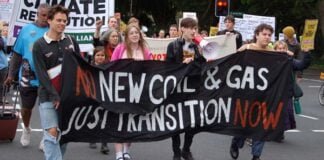
Climate change campaigners are organising to protest at Hazelwood power station in Victoria’s Latrobe Valley to highlight the need to transition from coal to renewable energy.
Review:Climate action By Mark Diesendorf
UNSW Press, $34.95
There was much media fanfare about the G8’s decisions on climate change, intended to be a step towards global negotiations in Copenhagen in December.
Leaders tried to spin the line that their agreement to keep temperature rises to 2 degrees was “historic” progress. But the commitment will amount to literal hot air.
Rudd’s CPRS has sent the message that big polluting companies can continue business as usual well into the future. The consequences are on display in NSW.
Lack of political clarity has held back the climate movement’s ability to galvanise opposition to Rudd’s climate policies and mount an effective challenge to the government. Power Shift, a “youth climate conference” that drew 1000 people in Sydney this month, was an example of the worst of these problems. It was exactly what the climate movement didn’t need.
Environment activists at the recent Students of Sustainability conference made a solidarity trip to visit workers on strike at the Hazelwood power station in Victoria.
Plan B, a program for immediate action to reduce emissions across all sectors of the Australian economy, was recently released by a coalition of environment groups, including Environment Victoria, Friends of the Earth, Greenpeace, The Wilderness Society, and various conservation councils.
The changes to the Rudd government’s Carbon Pollution Reduction Scheme (CPRS), announced in early May, have shown clearly where the government’s priorities lie.
Much has been made of the government’s commitment of $1.5 billion to a ‘Solar Flagships’ program in the budget.
Climate change has moved to the centre of Australian politics, and Rudd Labor’s climate opportunism is graphically on display. Having tried to lure Turnbull’s Liberals into voting for his CPRS by cutting the carbon price and offering to postpone it for a year, the Environment Minister Penny Wong is back to wooing The Greens.
In the face of Rudd’s failure to take serious action on climate change, we face the challenge of building the kind of movement that can force the government to shift. The 1970s anti-uranium movement provides rich lessons in how to build one.
Review: Global Warming and the Political Ecology of Health , By Hans Baer and Merrill Singer
Left coast press, $49.95
*No compromise with Rudd’s flawed scheme. More than ever the CPRS is worse than useless*
Recent developments around the Rudd government’s Carbon Pollution Reduction Scheme (CPRS) highlight the need for the climate movement to clearly oppose and mobilise against the scheme in its entirety.
The Carbon Pollution Reduction Scheme (CPRS) is the Rudd government’s central policy for dealing with climate change. The gap between rhetoric and reality is revealed starkly by a looking at how the scheme is supposed to work.
Organising groups in all states are preparing for upcoming climate change rallies around World Environment Day, likely to be Saturday June 13. The rallies are part of four national mobilisations this year called by the Climate Action Summit.
Rudd’s Carbon Pollution Reduction Scheme (CPRS), the government’s key mechanism for addressing climate change, is under fire on all sides. It’s not hard to see why.
We face two global crises, climate change and economic collapse. The answer to both is climate jobs, or what some have been calling a “green new deal”.
Solidarity spoke to two leading climate activists, John Hepburn from Greenpeace Australia Pacific and Damien Lawson from the Victorian Climate Action Centre, about the campaign against Rudd’s Carbon Pollution Reduction Scheme
Over five hundred people, representing 150 different groups active around climate change, took part in the climate action summit in Canberra from January 31 to February 3, culminating in a protest of around 2000 people at the opening of parliament.
The devastating Victorian bushfires should have been a harsh wake up call for Kevin Rudd. While Rudd comforted survivors and promised millions to rebuild the region, he has avoided the obvious—inaction on climate change will mean more bushfires.
Only a few years ago mainstream debate on climate change was still focused on debates with climate skeptics about whether the threat was real. Today climate change is a mainstream issue—it was one of the key issues in bringing Kevin Rudd to power in late 2007 and tackling it has moved to the center of the new government’s agenda. But this shift also means the climate movements needs to reorient itself to deal with the new situation.
Late this month the first national summit of climate action groups will be held in Canberra.
A common response to the climate crisis is to argue for restrictions on individuals’ energy use. As a result some environmental activists have supported initiatives like congestion charges or carbon rationing and even welcomed recent increases in petrol prices, since they might result in people being forced to use less petrol.
The world may be in great danger, but the annual summit of governments designed to progress a global agreement on climate change did very little to bring action.
The Australian government’s proposed Carbon Pollution Reduction Scheme (CPRS) is more about profit than planet.
The Walk Against Warming rallies this year were smaller that last. This is largely because they had no particular clear demands, and they did not take a position on carbon trading.
In the 1970s the Builders Labourers’ Federation led inspiring struggles in defence of the natural environment. Emma Torzillo looks at the history of an inspiring struggle when workers took industrial action and declared the social responsibility of labour
Review: Stop Global Warming: Change The World
By Jonathan Neale
Bookmarks, $30.00 from Solidarity
Review: “Now or never”, Quarterly Essay 31
By Tim Flannery
Black Inc, $15.95
Review
Bookmarks, 2008, $30.00 from Solidarity
IN HIS final report to the government, Professor Ross Garnaut echoes the calls from industry to abolish the one measure the Rudd government has in place that will actually make any difference in the climate crisis: the Mandatory Renewable Energy Target (MRET) of 20 per cent by 2020.
The Sydney Morning Herald headline said it all about Professor Ross Garnaut’s latest round of reports: “Sigh of relief from business”.
A proposal to build a major new solar power station in the Pilbara region of Western Australia has been largely ignored by the mainstream press.
THE BELIEF that the Rudd government will bring change is still strong. But many people wish the government was moving more quickly to undo Howard’s legacy.
ON JULY 15, 150 people including Climate Camp participants, local Newcastle residents, and unionists, held a lively picket of NSW Treasurer and climate change denier Michael Costa, against electricity privatisation and for green jobs.
COAL TECHNOLOGY company HRL (run by Channel Seven boss Kerry Stokes), the Chinese corporation Harbin Power and the Brumby Government have signed a formal contract to build a new $750 million dollar coal-fired power stations, in the La Trobe Valley.
AT THE heart of both Ross Garnaut’s interim report and the Rudd government’s Green Paper is the proposals for an Emissions Trading Scheme (ETS). The ETS is presented as the only option in the mainstream debate over how to deal with global warming.
AUSTRALIA’S ENERGY [R]evolution is a useful tool for the climate movement. Greenpeace researchers have drawn together the best science and technology to build a concrete and achievable vision of a viable transition to a low-emission society.
YET AGAIN the presidents and prime ministers of the richest countries have put their “national interests” ahead of the need for urgent cuts in carbon emissions.
Climate Camp, a protest against the coal industry in Newcastle NSW, was a success and an important step forward in continuing to build a movement for real solutions to stop global warming. It brought hundreds of activists together for a week of discussion and protest, and the main protest on Sunday drew 1000 people with the goal of shutting down a coal train line for the day. This direct action was a breath of fresh air, compared to the mainstream environment movement’s focus on individual action and lobbying politicians.
Professor Ross Garnaut delivered his draft report examining the “impacts, challenges and opportunities” resulting from climate change to the federal and state governments on July 4. His recommendations will shape the Rudd government’s response to global warming.
The environment movement needs to respond—to expose the shortfalls of Garnaut’s “solution” and outline the real alternatives.
Individuals reducing their energy consumption will do nothing to tackle climate change
The threat of dangerous climate change is now widely acknowledged. So why won’t governments take serious action? Chris Breen examines the major proposed market solutions—and the alternatives.
About 4000 people rallied in central Melbourne on Saturday July 5, addressed by Greens Senator Bob Brown, among others.
IN JULY hundreds of people will converge in Newcastle in a week long camp, with the aim of drawing attention to Australia’s contribution to climate change and rejuvenating the wider campaign for climate action.
Measures that could genuinely tackle rising carbon emissions are being held back by the desire of individual countries not to harm their economy’s global competitiveness, writes Shannon Price.
IS RUDD’S honeymoon coming to an end? Recent weeks have seen him blunder over fuel prices, his Howardesque moralism over Bill Henson and brewing battles with unions over pay disputes and the rollback of Workchoices.
Solidarity has produced a climate change position paper to coincide with the Climate Camp in Newcastle in July. It runs through, in some detail, our critique of the climate camp’s focus on coal exports, the myth of the individual carbon footprint, and what sorts of demands and organisation are needed to constitute a movement post-climate camp.
Massive ice loss in both the Arctic and Antarctic indicate that we are passing important climate tipping points. This mounting evidence of the need for serious solutions to climate change sits as a background to Professor Ross Garnaut’s Review, due to be released in full later this year.
KEVIN RUDD’S future summit, Australia 2020, will be held in Canberra on April 19 and 20. It could have been a chance for a real discussion about dismantling Howard’s legacy and tackling the looming economic crisis. Instead, Rudd will be sitting down with executives from Macquarie Bank, BHP Billiton and Westpac.
On March 1 more than 80 activists met to create “Climate Code Red Network” (CCRN). This came after more than 200 activists from across Victoria came together in February to begin a new movement to stop global warming.
PROFESSOR ROSS Garnaut, establishment economist and China expert, dropped a bombshell in his interim report on climate change, jointly commissioned by state and federal governments.
HOW DO we make governments act on the climate crisis? The organisers of Earth Hour believe “the simple action of turning off the lights for one hour”-at 8pm on March 29-will “deliver a powerful message about the need for action on global warming”.
Kevin Rudd tells us that he is pulling together the “best and brightest” 1000 Australians for his 2020 summit in Canberra in April. Rudd has already been hammered for selecting only one woman, Cate Blanchett, among the 11 prominent Australians who will help select the participants. But it is not just Rudd’s gender blindness that is a problem.
Wide opposition to new Melbourne freeway
The Climate Camp in Newcastle (10-15 July) will bring together climate activists from around Australia.
Why is the Rudd government so keen on “clean coal” as a solution to the climate crisis?
STRIKES, PROTESTS and riots over the cost and availability of food have swept across Burkina Faso, Somalia, Cameroon, South Africa, Ivory Coast, Mauritania, Senegal, Egypt, Yemen, Indonesia, Morocco and Bangladesh. “Peace-keeping” forces in Haiti fired tear gas and rubber bullets at protesters after days of unrest there.
Almost 60 people attended a Melbourne public meeting in solidarity with those arrested following the protest against the G20 summit in 2006. The meeting was part of an ongoing campaign to defend those arrested and oppose the attack on the right to protest.