
Lachlan Marshall explains how the First World War was the logical outcome of the drive to divide the world into rival empires, not simply a tragic mistake
This year is set to see an outpouring of nationalism and glorification of war as official celebrations of the centenary of the First World War begin.
Hardly had the year begun when British Education Secretary Michael Gove proclaimed that it was “plainly a just war.”
Australia’s Education Minister, Christopher Pyne, in his attack on the “cultural left” bias in the school curriculum, wants it to focus more on the pointless slaughter at Gallipoli. The government is setting aside $80 million for the centenary of the Gallipoli landing in April 2015.
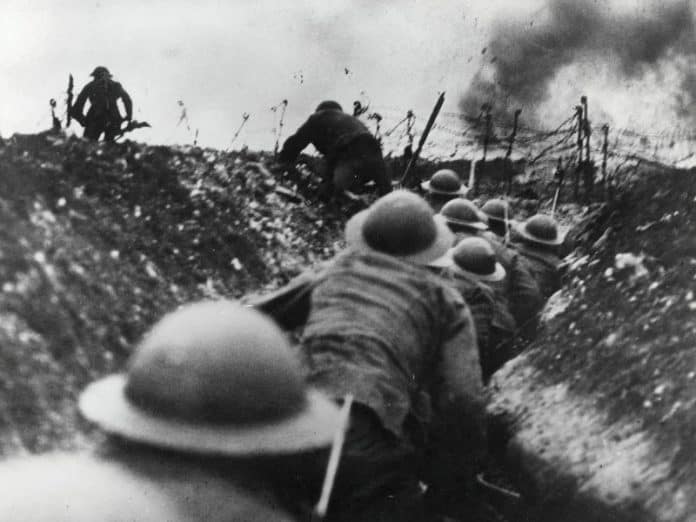
WWI was an event of unprecedented slaughter, due to the sheer industrial scale of the fighting. Trench warfare, with soldiers stuck knee-deep in mud and equipped with the products of the modern arms industry, resulted in some 20 million deaths.
The sheer pointlessness of much of the killing is almost beyond belief. There were one million casualties in the battle of the Somme in five months, resulting in the gain of less than eight kilometres’ territory. Novel methods of killing like chemical weapons were pioneered, as described by war poets like Wilfred Owen.
WWI is often regarded as merely the result of mistaken policies and accidental events.
But in fact it was the direct product of capitalist development and the lucrative empires built by the European powers across the globe. The forces propelling Europe to prosperity contained the seeds of war.
Colonial carve up
Far from serving any noble or democratic purpose, the First World War was a clash between rival European powers desperate to maintain or extend their global empires.
Britain and France had led the carve-up of colonies in the “backward” world.
In some cases, in able to safeguard profitable investments conditions overseas, European states took over administration directly. Egypt came under British military rule to safeguard the profits of the Suez Canal Company in 1882—a strategic asset on the route to the “jewel in the imperial crown”, India.
After the depression of the 1870s-80s, the expansion in foreign investment and trade into the colonies gave a new lease on life to the world economy (however, the vast bulk of trade remained between developed economies).
Colonial protectionism, designed to exclude economic rivals from markets and resources within their respective colonial empires, exacerbated this trend.
In 1897 the British premier to the French ambassador commented, “If you were not such persistent protectionists, you would not find us so keen to annex territories.”
The “scramble for Africa” in the last quarter of the 19th century became emblematic of the sharpening rivalry between empires. While as late as 1876, the proportion of Africa under European control was 10.8 per cent, by 1900 it had soared to 90.8 per cent.
The Berlin Conference of 1884 was called to regulate and formalise this carve-up of Africa.
A similar trend, though less dramatic, was taking place on other continents. The European powers were quickly partitioning all unclaimed patches of the globe.
In this period Britain and France seized most of Africa, France took Indochina, Holland expanded its hold over present-day Indonesia, the US took the Philippines, Cuba and Puerto Rico, while Japan invaded Korea and Taiwan.
Economic interests
Revolutionary opponents of the war like the Russian Bolsheviks Nikolai Bukharin and Vladimir Lenin developed a Marxist theory of imperialism to explain this process. They saw imperial expansion and the consequent preparation for war as a result of competition between nation states for territory and resources in the interests of their national economies.
The world economy experienced a “Great Depression” from 1873-96, followed by another economic crisis in 1900.
These crises weeded out smaller enterprises and led to the concentration of industry for the first time into the hands of large firms and the formation of “cartels”, particularly in heavy industry.
This concentration of production created national monopolies in each industry. Bukharin described this process where monopolies came to dominate the economies of the Great Powers and, “unite the entire ‘national’ production, which assumes the form of a company of companies, thus becoming a state capitalist trust. Competition reaches its highest, the last conceivable, stage of development. It is now competition of the state capitalist trusts on the world market.”
Increasingly, firms that had a direct stake in empire came to dominate their national economies. Industrialists and financiers pressured their respective states to secure raw materials in far-flung parts of the world and to protect their growing investments there.
The expansion of capitalist operations couldn’t be contained within national boundaries. As Marxist historian Eric Hobsbawm noted, “the characteristic feature of capitalist accumulation was precisely that it had no limit. The ‘natural frontiers’ of Standard Oil, the Deutsche Bank, the De Beers Diamond Corporation were at the end of the universe, or rather at the limits of their capacity to expand.”
But monopoly interests abroad could only be advanced through collaboration with the national state and its military, fusing business and the state closer together.
Thus economic competition within the nation state was increasingly displaced by geopolitical competition between states over control of territory and resources.
Imperialism
In his pamphlet, Imperialism: The Latest Stage of Capitalism, written in the middle of WWI, Lenin described how the capitalist powers had divided the world according to, “a calculation of the strength of the participants, their general economic, financial, military and other strength.”
But this imperial expansion had limits. By the outbreak of war in 1914 European empires covered 84 per cent of the globe. In Lenin’s words: “For the first time the world is completely divided up, so that in the future only redivision is possible, i.e., territories can only pass from one ‘owner’ to another, instead of passing as ownerless territory to an owner.”
But whatever divisions of territory were arrived at could never be more than temporary.
As the balance of power between the different capitalist states shifted, new economic powers began to catch up with and threaten to overtake the countries that had industrialised first like Britain. This then created pressure from the emerging powers for a redivision of empires and spheres of influence, as they too sought access to markets and raw materials around the globe.
But the demands for a re-partitioning of the world could only be settled by force.
Germany, for instance, the only European nation to rival Britain industrially, joined the race to empire late. It felt its growing economic predominance warranted an empire of its own, its “place in the sun,” as German foreign minister, von Bülow put it. But it found itself confronted by the fact that most of the world was already claimed by the existing imperial powers.
This meant the rival empires increasingly required the threat of arms to keep other powers in check. Indeed, the development of national arms industries accelerated the collaboration between big business and the state. As Friedrich Engels had observed in 1892: “as warfare became a branch of the grande industrie…la grande industrie…became a political necessity.”
This necessity became acute at the turn of the century. In the mid-19th century all the world’s navies combined couldn’t equal Britain’s, which “ruled the waves.” The British navy was vital to maintaining a far flung empire that stretched the globe.
From 1898 the German ruling class began building a navy to rival Britain’s. German naval expenditure more than quadrupled in the two decades preceding WWI, while British military expenditure also rose, though not as dramatically.
A navy to match Britain’s based just across the North Sea in Germany was a major threat to British power and economic interests.
Australia joined this drive to militarisation with the creation of the Royal Australian Navy between 1911-14, the introduction of compulsory military training in 1911 and a doubling of the size of the army. An astounding 31 per cent of the Australian federal budget was devoted to defence.
Alliances
It is against this backcloth that a web of alliances developed, splitting Europe into two rival blocs, the Triple Entente (Britain, France and Russia), and the Central Powers (the Austro-Hungarian and Ottoman Empires, headed by the economic upstart, Germany).
The prelude to the First World War saw aspiring empires clash with established ones as each manoeveured for a piece of the action, for instance in wars between the US and Spain (1898), and Japan and Russia (1904-05).
Importantly, the disintegration of the Ottoman Empire gave rise to movements for independence amongst its constituent nationalities, endangering the stability of the likewise multi-ethnic Austro-Hungarian (or Hapsburg) Empire.
The subsequent conflicts between the Balkan states of south east Europe in 1912-13 raised the tensions between their Great Power allies to breaking point.
In June 1914 the heir to the Hapsburg throne, Austrian Archduke Franz Ferdinand was scheduled to visit Sarajevo, the capital of the Austrian-ruled province of Bosnia. Its Serbian population regarded the visit as a provocation.
A group of Serbian nationalists made plans to assassinate him, and on 28 June, one of their number shot him dead. The fuse was lit.
The assassination was an affront to the Hapsburg Empire, which, conscious of its declining status as a Great Power, sought retribution against Serbia.
On 23 July, with German support, Austria offered Serbia an ultimatum. Serbia agreed to all conditions, but resisted on one point: the involvement of Austrian officials in the investigation of the murder. This Serbia regarded as unwarranted meddling in its affairs.
On 28 July Austria retaliated by declaring war on Serbia. Russia viewed an Austrian invasion of Serbia as an unacceptable concession and declared war on Austria. On 1 August Germany declared war and invaded Luxemburg then Belgium.
Shortly after France, fearful of German dominance of Europe, also joined the fray. A British ultimatum to Germany to withdraw its forces from Luxemburg expired at midnight on 4 August and the stage was set for the “Great War.”
This was Australia’s cue to join the conflict. Australia had already demonstrated its enthusiasm for imperialist ventures, sending troops to fight alongside the British in 1885 in the Sudan, in 1899-1902 in the Boer War, and in 1900 in the Boxer Rebellion in China.
The Australian colonies had their own imperial ambitions in the local region. Anxious at rumoured German interest in the region, they pressured the British government to annex New Guinea in 1884, which was handed over to Australia in 1906.
Apart from loyalty to empire, Australia’s enthusiasm for war stemmed from a long-standing paranoia over foreign invasion by first the Chinese then Japan and this perceived threat to White Australia (despite Japan being an ally in the war).
As Australia’s official war historian CEW Bean put it, “only in one point was the Australian people palpably united, in a determination to keep its continent a white man’s land.”
Having invaded the continent and stolen the land themselves from the indigenous inhabitants, Australia’s early rulers were paranoid that another major power might attempt to dispossess them in turn.
Located far from Europe and with an enormous coastline to defend, Australia’s rulers were keen to draw Britain as far into controlling the region as possible.
In Australia’s federal election campaign of 1914 both parties trumpeted their support for war. Prime Minister Fisher famously vowed to defend the Empire “to our last man and last shilling.”
After re-election on 5 September the Labor government wasted no time in expanding Australia’s imperial reach, taking over German New Guinea.
Meanwhile the population of 33,000 German-Australians living here were declared a “nest of traitors” and thousands were detained as enemy aliens in concentration camps.
What was it for?
This was no war for democracy. Unlike its antagonist, Germany—which had already granted universal suffrage—only a minority of British men, and no women, had the vote; never mind its alliance with the feudal autocracy in Russia or the outright rejection of democracy for Britain’s colonial subjects.
On the centenary of the war, there is nothing to celebrate. This was a war fought in defence of empire and profit. Ordinary working class people marched off to die in their millions for the imperialist and commercial interests of their respective ruling classes.
Our rulers were content to hurl millions of people into the hell of war in defence of their own profits and privileges. The workers of the respective countries had nothing to gain by supporting their own nation.
It would be the rising up of these same masses against their own rulers, in part from revulsion at the war, that would eventually put an end to the bloodshed.
This article is the first in a Solidarity series on the centenary of Australia’s involvement in the First World War